




„Stay awake, for you do not know when the lord of the house will come.”
The week at a glance
Saints and commemorations: 29 November – 5 December
Liturgical status is shown for each date. The parish's own biographies are linked directly; where no dedicated parish article is available, clearly labelled external references are accompanied by the parish's Lives of the Saints section.
Daily liturgical reflections
Sunday Year B and weekday Cycle I begin on 29 November 2026.
First Sunday of Advent — Stay awake and open your heart
Saint Saturninus is remembered in the Church’s martyrology. On this Sunday, the liturgy of the First Sunday of Advent is celebrated. The parish also marks the traditional beginning of the novena before the Immaculate Conception.
Be watchful, be alert; you do not know when the time will come (cf. Mark 13:33).
Liturgical reflection
The First Sunday of Advent opens a new liturgical year and invites the Church to look towards the coming of Christ without forgetting his presence here and now. Isaiah cries out for God to come down and renew a wounded people. His prayer arises from human weakness but refuses to surrender hope. Saint Paul gives thanks for the grace entrusted to believers and assures them of God’s faithfulness. In the Gospel, Jesus describes a householder who entrusts responsibilities to servants while he is away. Christian watchfulness is not anxious speculation about the future. It means remaining faithful to our duties, forgiving others and recognising Christ in everyday life. The first candle on the Advent wreath speaks of a hope that gently illuminates ordinary relationships. For the Polish parish community in Peterborough, this Sunday also begins the immediate preparation for the Advent retreat and for a renewed rhythm of family prayer.
Lord Jesus, awaken my heart when routine weakens my faith. Teach me to wait with hope and to notice those who need my presence.
Light the first Advent candle, read Mark 13:33–37 and make one deliberate gesture of reconciliation.
The First Sunday of Advent takes precedence. Sunday readings begin Year B and weekday readings enter Cycle I.
Feast of Saint Andrew — Responding to the call
The brother of Simon Peter and one of the first disciples called by Jesus. The Christmas devotion popularly called St Andrew’s Novena begins on this date and continues until 24 December.
Come after me, and I will make you fishers of men (Matthew 4:19).
Liturgical reflection
Andrew, the brother of Simon Peter, belongs among the earliest disciples who recognised Jesus as the Messiah. Matthew’s Gospel meets him amid his ordinary work: he is casting a net when Christ calls him to a new life. Andrew cannot see the entire road ahead, yet he responds. Paul’s Letter to the Romans connects faith with hearing the word and with people willing to proclaim it. As patron saint of Scotland, Andrew is particularly close to the Christian memory of Britain. His witness also speaks to Polish families living abroad. A change of country does not require leaving faith behind; following Christ may take the form of quiet hospitality, patient service and a simple invitation to pray. Advent begins not with having everything planned, but with learning to recognise a voice worth trusting.
Saint Andrew, help us answer the Lord with generosity. Intercede for families seeking a home and longing to remain faithful.
Read Matthew 4:18–22 and invite someone to share a short moment of prayer.
Saint Andrew, Apostle, brother of Saint Peter and patron saint of Scotland; the feast replaces the Advent weekday.
A shoot from the stump of Jesse — Peace begins within
These three martyrs died in London on 1 December 1581. Their witness has particular significance for Catholics in England, although the universal calendar lists the day as an Advent weekday.
The spirit of the Lord shall rest upon him (cf. Isaiah 11:2).
Liturgical reflection
Isaiah presents the promised Messiah as a shoot emerging from the seemingly exhausted stump of Jesse. Endowed with the spirit of wisdom and understanding, he brings justice for the poor and opens the horizon of a reconciled creation. The famous image of a wolf dwelling with a lamb is not a denial of suffering; it is a vision of the peace God desires. In Luke, Jesus rejoices that the Father reveals his mysteries to the little ones. The Gospel does not reject learning, but it does challenge pride and self-sufficiency. On this first day of December, the Church asks whether our households have become places where someone may speak without fear, where the weak are defended and where reconciliation is possible. Advent peace often begins with a modest but difficult decision not to repay anger with anger.
Prince of Peace, replace harsh judgement with gentleness in my speech. Give me the wisdom to build trust and understanding.
Listen patiently to someone with whom you do not easily agree.
Advent weekday; the readings focus on the Messiah, justice and peace.
A banquet for every people — Christ sees our hunger
A Roman martyr honoured in the Church’s tradition. The ordinary liturgy of Advent remains centred on God’s promise of salvation and Christ’s mercy.
My heart is moved with pity for the crowd (Matthew 15:32).
Liturgical reflection
Isaiah describes a banquet prepared by God for all peoples, where the veil of sorrow is removed and tears are wiped away. The promise is strikingly inclusive: salvation is not reserved for a select circle. In the Gospel, Jesus receives the sick and the hungry with compassion. He does not simply preach about divine care; he heals and feeds a large crowd. The disciples can offer only a little food, but placed in Christ’s hands it becomes a sign of abundance. Advent therefore joins the longing for the final fulfilment of God’s promises with immediate works of mercy. Think of the elderly, people living alone, those struggling with the cost of living or newcomers without a support network. Sometimes the most precious gift is a shared meal; sometimes it is the patient presence of someone willing to listen.
Lord, you feed the hungry and comfort those who grieve. Open my hands and help me notice the people closest to me.
Share food, offer practical help or contact someone who may be lonely.
Advent weekday; the scriptural theme is God’s compassionate care for all peoples.
Saint Francis Xavier — A faith that goes out to others
Jesuit missionary in Asia and patron of the missions. An invitation to pray for those bringing the Gospel across boundaries of language, distance and culture.
Everyone who listens to these words of mine and acts on them is like a wise man (cf. Matthew 7:24).
Liturgical reflection
Francis Xavier, one of the first Jesuits, travelled across Asia to share the Gospel and encounter peoples of many languages and cultures. His missionary zeal reminds the Church that faith is never meant to remain enclosed within personal comfort. Yet the Gospel on this day supplies an essential foundation for every mission: the wise person builds upon the rock by hearing and doing what Christ teaches. Calling Jesus “Lord” is not enough if love, honesty and mercy are absent from our choices. Those living far from their country of birth can witness to the Gospel through trustworthy work, respect for neighbours and care for families adjusting to a new society. Not every missionary travels to the other side of the world. Some are sent to an anxious colleague, a lonely neighbour or an overlooked member of the parish.
Saint Francis Xavier, pray that we may speak of Christ with courage and treat people of every background with respect.
Pray for missionaries and offer genuine kindness to someone outside your usual circle.
Saint Francis Xavier (1506–1552), priest, missionary and co-founder of the Society of Jesus.
Let us see again — The Advent retreat begins
John Damascene was a Doctor of the Church and defender of sacred icons. Saint Barbara, traditionally honoured as a martyr and patron of miners, is especially cherished in Polish Catholic culture.
Let it be done for you according to your faith (Matthew 9:29).
Liturgical reflection
Two blind men call out for mercy. Before they receive their sight, Jesus asks whether they believe in his power to heal. Their encounter becomes an invitation to recognise the kinds of blindness that close our hearts to truth and to other people. Isaiah anticipates a day when the deaf hear and the eyes of the blind see. Those words provide a fitting setting for the Advent retreat announced in Peterborough for 4–6 December, led by Fr Roman Werner TChr as he begins his parish ministry. A retreat is more than an additional event in a busy December calendar. It is an opportunity to stop, hear Scripture afresh, examine one’s conscience and seek reconciliation. The Church also remembers Saint John Damascene, a teacher of the faith and defender of sacred images; in Polish religious tradition this date also carries the memory of Saint Barbara.
Jesus, open my eyes to the truth about myself and to your mercy. Bless the retreat preacher and everyone who takes part.
Make room for the retreat and a quiet examination of conscience. Check parish announcements for the detailed timetable.
Saint John Damascene, Priest and Doctor of the Church (optional memorial); Saint Barbara is also remembered in Polish devotional tradition.
Freely received, freely given — Sent to serve
A monk and abbot of the Holy Land, remembered for his prayer and asceticism. On Saturday evening the Church begins its celebration of the Second Sunday of Advent.
Without cost you have received; without cost you are to give (Matthew 10:8).
Liturgical reflection
Isaiah promises that God will hear the cry of his people and show them the way forward. In Matthew, Jesus sees crowds who are troubled and abandoned, like sheep without a shepherd. His compassion leads to action: he calls disciples and sends them to people in need. Christian faith matures when a gift received becomes a gift shared. As the parish Advent retreat continues, the day is an invitation to allow prayer and preaching to bear fruit in concrete service. The Roman Martyrology also remembers Saint Sabbas, an abbot whose life points to the lasting strength of prayer and community. As evening arrives, the Church begins the Second Sunday of Advent liturgically. A second candle will be lit not simply to decorate a home, but to remind us that each passing day offers another chance to make room for Christ.
Good Shepherd, do not let me keep your gifts only for myself. Teach me generosity, attentive listening and practical care.
Do one good deed without expecting recognition. Prepare for the Second Sunday of Advent and the retreat’s final day on 6 December.
Saint Sabbas, Abbot, is remembered in the Roman Martyrology. In the evening the Church begins the Second Sunday of Advent.
Polish Catholic Parish in Peterborough
Parish information follows the bulletin of 22 November 2026 and earlier announcements. The retreat timetable may be updated; consult current parish notices before travelling. Some linked parish articles are in Polish because individual English article URLs have recently had access problems.
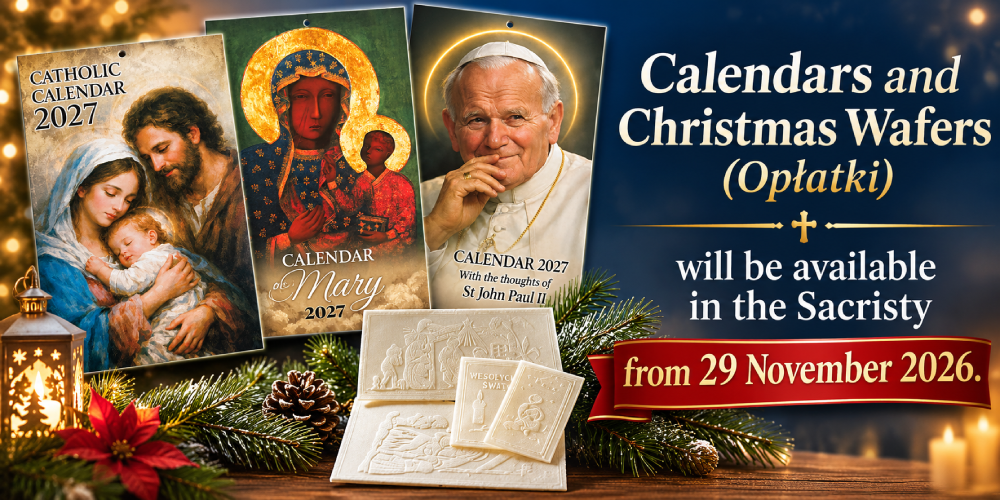
Masses in Peterborough: 7:30 am, 10:45 am, 12:30 pm and 7:15 pm. Mass in Wisbech: 3:30 pm. Blessed Christmas wafers (opłatek) are available from the sacristy.
The feast of St Andrew and the traditional start of the Advent Christmas Novena, prayed from 30 November to 24 December.
A 10:00 am Mass for senior parishioners is listed for Wednesday; the evening Mass at 7:15 pm has an intention for the St Padre Pio prayer group.
The parish retreat led by Fr Roman Werner SChr runs 4–6 December during Masses. Friday Rorate Mass is at 7:15 pm; confessions from 6:00 pm.
Rorate Mass at 7:00 am followed by breakfast; Rosary at 6:00 pm and confessions from 6:00 pm. The parish retreat continues.
The altar servers and their families are organising a Christmas fair on 6 December. The parish bulletin directs readers to the event posters for full details.
Roman Martyrology and the memory of the saints
During the first week of Advent the liturgy directs the Church towards the coming of Christ. Feasts and memorials show different responses to his call; optional memorials do not automatically replace the Advent weekday.
Sunday, 29 November 2026 — St Saturninus of Toulouse
Saint Saturninus is remembered in the Church’s martyrology. On this Sunday, the liturgy of the First Sunday of Advent is celebrated. The parish also marks the traditional beginning of the novena before the Immaculate Conception. Remembrance in the Martyrology does not necessarily imply a separate liturgical celebration in the calendar of England and Wales.
St Saturninus — Catholic Online Novena before the Immaculate Conception — parish (PL)
Monday, 30 November 2026 — Feast of Saint Andrew
The brother of Simon Peter and one of the first disciples called by Jesus. The Christmas devotion popularly called St Andrew’s Novena begins on this date and continues until 24 December. Remembrance in the Martyrology does not necessarily imply a separate liturgical celebration in the calendar of England and Wales.
Life of St Andrew — parish (PL) St Andrew Christmas Novena — parish (PL)
Tuesday, 1 December 2026 — St Edmund Campion, St Ralph Sherwin and St Alexander Briant
These three martyrs died in London on 1 December 1581. Their witness has particular significance for Catholics in England, although the universal calendar lists the day as an Advent weekday. Remembrance in the Martyrology does not necessarily imply a separate liturgical celebration in the calendar of England and Wales.
St Edmund Campion — Catholic Encyclopedia Lives of the Saints — parish (PL)
Wednesday, 2 December 2026 — St Bibiana (Viviana)
A Roman martyr honoured in the Church’s tradition. The ordinary liturgy of Advent remains centred on God’s promise of salvation and Christ’s mercy. Remembrance in the Martyrology does not necessarily imply a separate liturgical celebration in the calendar of England and Wales.
Thursday, 3 December 2026 — Saint Francis Xavier
Jesuit missionary in Asia and patron of the missions. An invitation to pray for those bringing the Gospel across boundaries of language, distance and culture. Remembrance in the Martyrology does not necessarily imply a separate liturgical celebration in the calendar of England and Wales.
Friday, 4 December 2026 — St John Damascene and St Barbara
John Damascene was a Doctor of the Church and defender of sacred icons. Saint Barbara, traditionally honoured as a martyr and patron of miners, is especially cherished in Polish Catholic culture. Remembrance in the Martyrology does not necessarily imply a separate liturgical celebration in the calendar of England and Wales.
Saturday, 5 December 2026 — St Sabas (Sabbas), Abbot
A monk and abbot of the Holy Land, remembered for his prayer and asceticism. On Saturday evening the Church begins its celebration of the Second Sunday of Advent. Remembrance in the Martyrology does not necessarily imply a separate liturgical celebration in the calendar of England and Wales.
St Sabas — Vatican City State Lives of the Saints — parish (PL)
Prayer for the first week of Advent
Lord Jesus Christ, who comes to your Church, teach us to wait for you with hearts at peace.
May the First Sunday of Advent renew our faith, and may Saint Andrew remind us that every person can answer your call.
Give us wisdom that heals divisions and generosity towards the hungry and the lonely. Through Saint Francis Xavier, strengthen all who proclaim the Gospel far from home.
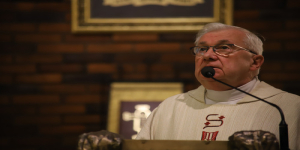
Bless the Polish Catholic Parish in Peterborough, Fr Roman Werner and all who take part in the Advent retreat. Grant the grace of reconciliation and lasting conversion.
May those we meet recognise something of your patience, goodness and hope in us. Come, Lord Jesus. Amen.
Further reading on the parish website
Liturgy and Mass readings were checked against the official England and Wales calendar and the Advent weekday lectionary. Parish notices: 22 November 2026. Parish bulletin (PL) · Fr Roman Werner (PL).
November 2026 — Liturgy Office · December 2026 — Liturgy Office · Advent weekdays — readings.